


March 13, 2026

The Mississauga walk-in clinic opened 40 minutes late on its first Monday morning. Twenty-three patients were waiting outside when the staff arrived — a...
Choosing a medical office renovation contractor is one of the most consequential decisions you will make for your practice. The wrong contractor means failed inspections, compliance violations, ICRA failures that expose your patients to infection risk, cost overruns, and a finished space that doesn't actually work for how your clinic operates. The right contractor means a renovation that comes in on time, passes every inspection, and delivers a space your staff and patients immediately feel the difference in.
The problem is that every contractor in Ontario claims to handle "medical offices." Very few actually understand the regulatory complexity, infection control protocols, and clinical workflow requirements that separate a competent healthcare renovation from a generic commercial fit-out. This 2026 guide gives you a systematic hiring framework: the credentials to verify, the questions to ask, the red flags to walk away from, and the contract terms you must insist on.

The right contractor brings verified credentials, a documented healthcare portfolio, and transparent processes — before a single wall is touched.
A kitchen renovation and a medical office renovation both involve trades, permits, and construction timelines — but that's roughly where the similarity ends. Medical facility renovation carries a layer of complexity that most general contractors are simply not trained for, and where their inexperience creates real consequences for your patients and your practice.
Consider what happens when a general contractor renovates one room of an active clinic without proper ICRA protocols: construction dust containing Aspergillus spores enters the HVAC plenum and is distributed to patient care areas. For immunocompromised patients — a population overrepresented in any waiting room — this is a genuine clinical hazard. This isn't a theoretical risk; it's a documented failure mode in healthcare construction that happens when contractors without clinical environment experience work in medical settings.
Beyond infection control, healthcare renovations must navigate a regulatory framework that general contractors rarely encounter: AODA accessibility standards with specific millimeter-level physical requirements, CSA Z8000 clinical space standards for room dimensions and ventilation rates, IPAC requirements for material selection and surface cleanability, and the Ontario Building Code's healthcare occupancy classification rules that go beyond standard commercial code. Navigating all of this simultaneously — while keeping your clinic operational — requires genuine specialist expertise.
Failed building inspections requiring demolition and rework, ICRA breaches requiring clinical decontamination, AODA non-compliance discovered post-construction, and change orders on work that should have been scoped from the start — these are the real financial risks of choosing a contractor without documented healthcare renovation experience. The cost difference between a specialist and a generalist at the quote stage is almost always smaller than the cost of fixing a generalist's mistakes.
Use this framework to structure your contractor evaluation process. Every criterion should be assessed before signing anything — not after you've chosen someone and are trying to justify the decision. For a broader look at how contractor selection fits into your full renovation planning process, see our step-by-step medical office renovation planning guide.
| # | Criterion | What You're Looking For | How to Verify |
|---|---|---|---|
| 1 | Healthcare Portfolio | Minimum 3 completed medical facility projects with photographs and verifiable client references | Request project list; call references directly; visit a completed project if possible |
| 2 | WSIB Clearance | Valid, current WSIB (Workplace Safety and Insurance Board) Clearance Certificate in the contractor's legal business name | Request the certificate; verify online at wsib.ca using their account number |
| 3 | General Liability Insurance | Minimum $2 million per occurrence; you as property owner or tenant should be named as additional insured | Request certificate of insurance from their broker — not from the contractor |
| 4 | ICRA Protocol Knowledge | Written ICRA (Infection Control Risk Assessment) plan; documented experience implementing containment barriers, negative air, and HEPA filtration in active clinical settings | Ask them to walk you through their ICRA approach; request a sample ICRA plan from a past project |
| 5 | Permit Management | Demonstrated ability to prepare or coordinate architectural drawings, submit permit applications, and manage all inspection scheduling | Ask which municipalities they have active permit history with; confirm this is included in scope, not billed as extra |
| 6 | Regulatory Knowledge | Working knowledge of AODA Design of Public Spaces Standard, Ontario Building Code barrier-free requirements, and CSA Z8000 | Ask specific questions about AODA counter heights and turning radii; see if they answer correctly without looking it up |
| 7 | Communication Systems | Clear written milestone schedule; defined point of contact; documented change order process; regular progress updates without you having to ask | Ask how they communicate during construction; request a sample schedule and change order form from a past project |
| 8 | Subcontractor Management | Established relationships with licensed electricians (ESA), licensed plumbers, and HVAC technicians experienced in healthcare environments | Ask who their electrical and plumbing subcontractors are; confirm those subs also have WSIB and insurance |
| 9 | Healthcare Material Knowledge | Familiarity with healthcare-grade flooring, wall systems, millwork, and surface specifications for infection control | Ask what flooring they specify for exam rooms and why; correct answer involves homogeneous sheet vinyl or welded-seam LVT — not ceramic tile |
| 10 | Written Warranty | Minimum 1-year workmanship warranty in writing, with clear process for post-completion service calls | Request their standard warranty document before signing the contract |
The contractor interview is your single best tool for separating genuine healthcare renovation specialists from generalists who think a medical office is just another commercial job. These questions are designed to surface real expertise — or expose the lack of it. A contractor who has done this work will answer these confidently and specifically. One who hasn't will give you vague generalities.
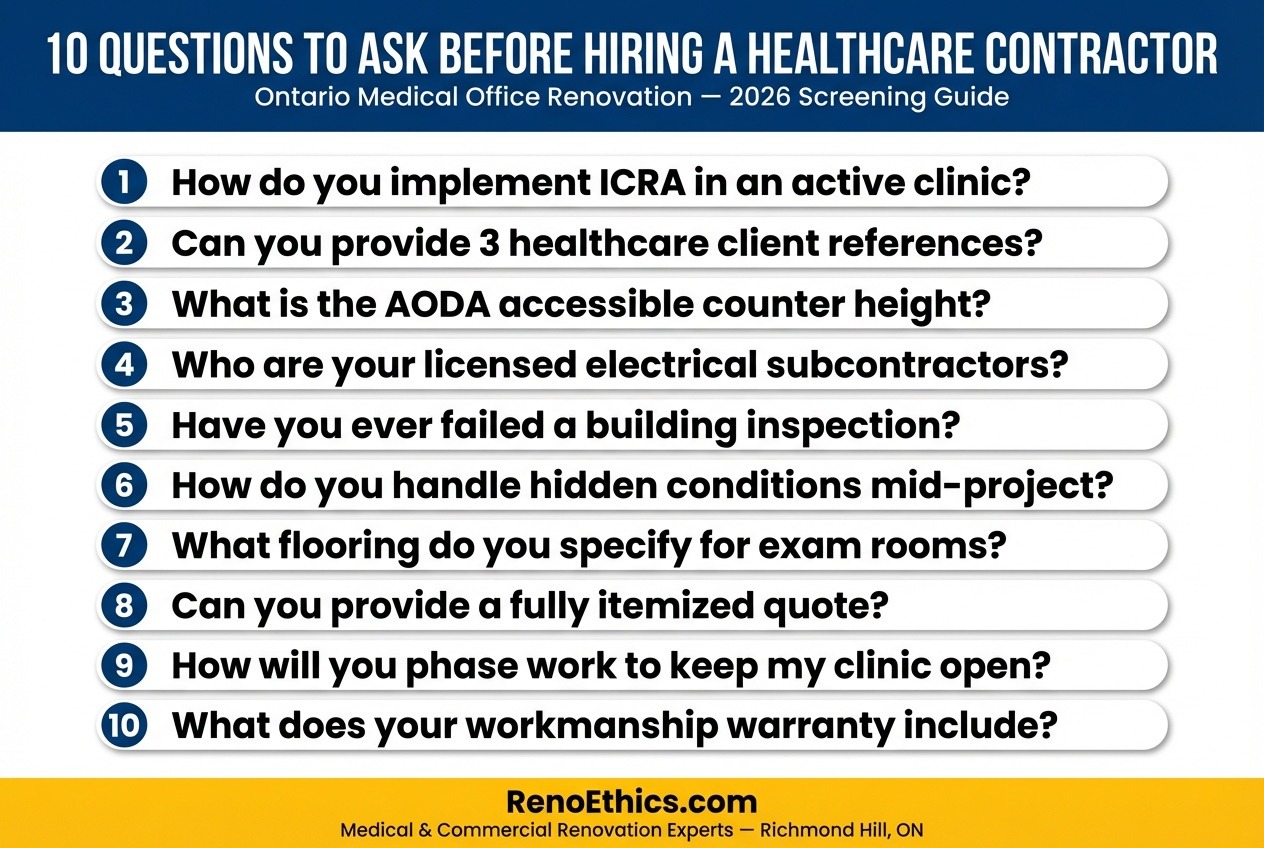
Save and share: The 10 questions every Ontario clinic owner must ask before hiring a renovation contractor.
Use this comparison during your evaluation process. Any single red flag warrants a very direct follow-up question. Multiple red flags in one contractor meeting is your answer — keep looking. Rushing contractor selection to start sooner is one of the top mistakes to avoid during healthcare renovations in Ontario.
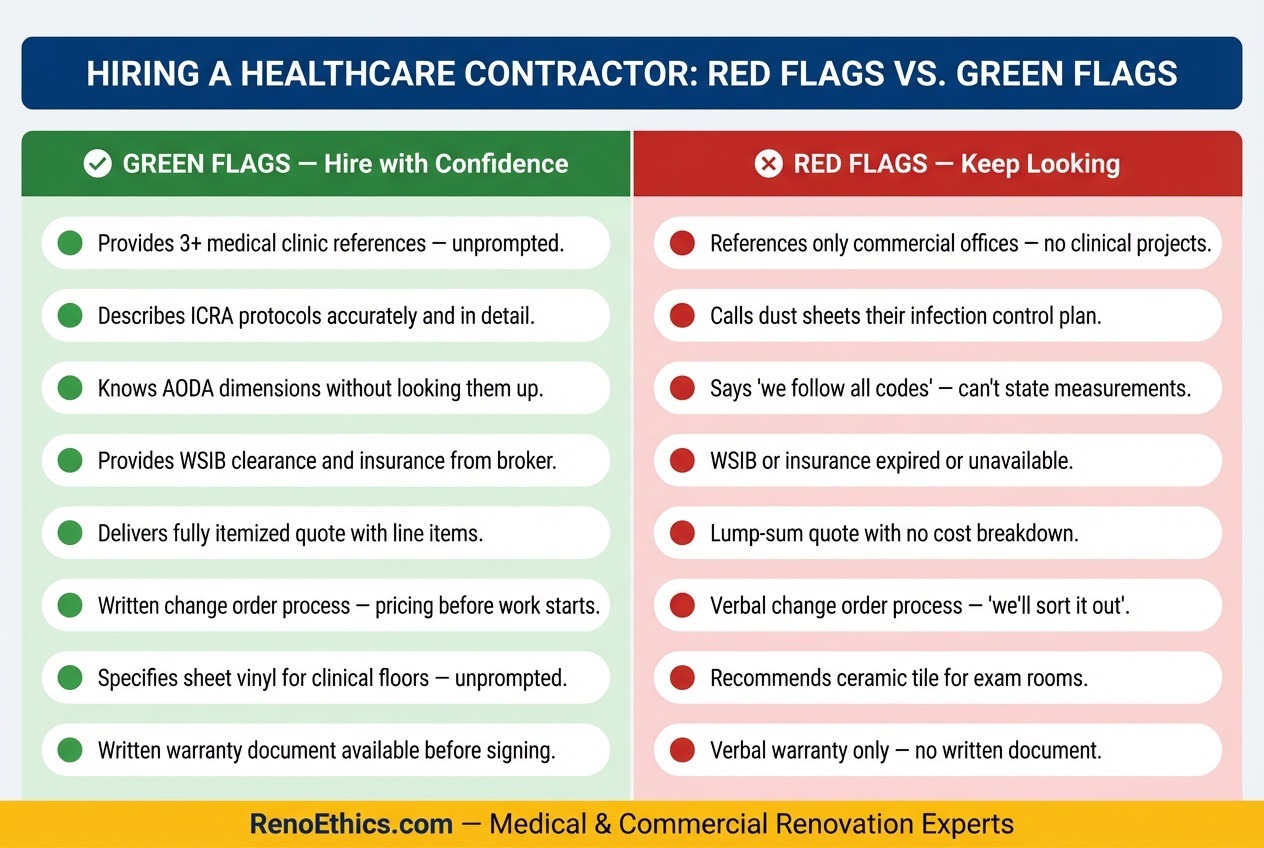
Save and share: The quick-reference red flag / green flag guide for evaluating healthcare renovation contractors.
Every credential below must be verified independently — not accepted on faith. Fraudulent or lapsed documentation is more common in the construction industry than most clinic owners expect. The five minutes it takes to verify each item could save you significant liability exposure.

Every document in this image should be on your desk before you sign a medical renovation contract.
Must be current (not expired), issued in the contractor's legal operating name, and verifiable at wsib.ca using their WSIB account number. If they work with subcontractors, each sub must also carry valid WSIB. Without this, you as the property owner or tenant can be held liable for workplace injuries on your premises.
Verify at wsib.caRequest this directly from the contractor's insurance broker — not from the contractor themselves. Minimum $2 million general liability per occurrence. Confirm the policy is active, covers commercial construction, and that you (as property owner or tenant of the renovation space) are listed as additional insured on the certificate.
Request from broker directlyA portfolio of completed medical facility projects with photographs, project descriptions, approximate scope and cost, and client contact information. Verify at least two projects by calling references directly. Ask references about budget adherence, inspection outcomes, ICRA compliance, and whether they would hire the contractor again.
Call at least 2 referencesAsk which municipalities the contractor has active permit history in across the GTA and York Region. A contractor who regularly pulls permits in Richmond Hill, Vaughan, Markham, and Aurora will have established relationships with local building departments — which means more predictable permit timelines and fewer surprises during inspections.
Ask for permit history by municipalityAll electrical work in Ontario must be performed by a licensed electrical contractor registered with the Electrical Safety Authority (ESA) — not just a general contractor with an electrician on payroll. Ask specifically whether the electrical subcontractor is ESA-licensed and whether they will pull their own ESA permit. ESA inspection is separate from your municipal building permit inspection, and both are required. A contractor who conflates these two processes does not understand Ontario's electrical licensing requirements.
The renovation contract is your primary protection against scope creep, cost overruns, schedule delays, and disputes. A vague contract benefits only the contractor. Insist on specificity in every section — and if a contractor resists providing detailed contract terms, treat that as a red flag. For a printable pre-construction checklist that integrates contractor and contract requirements, see our medical office renovation planning guide.
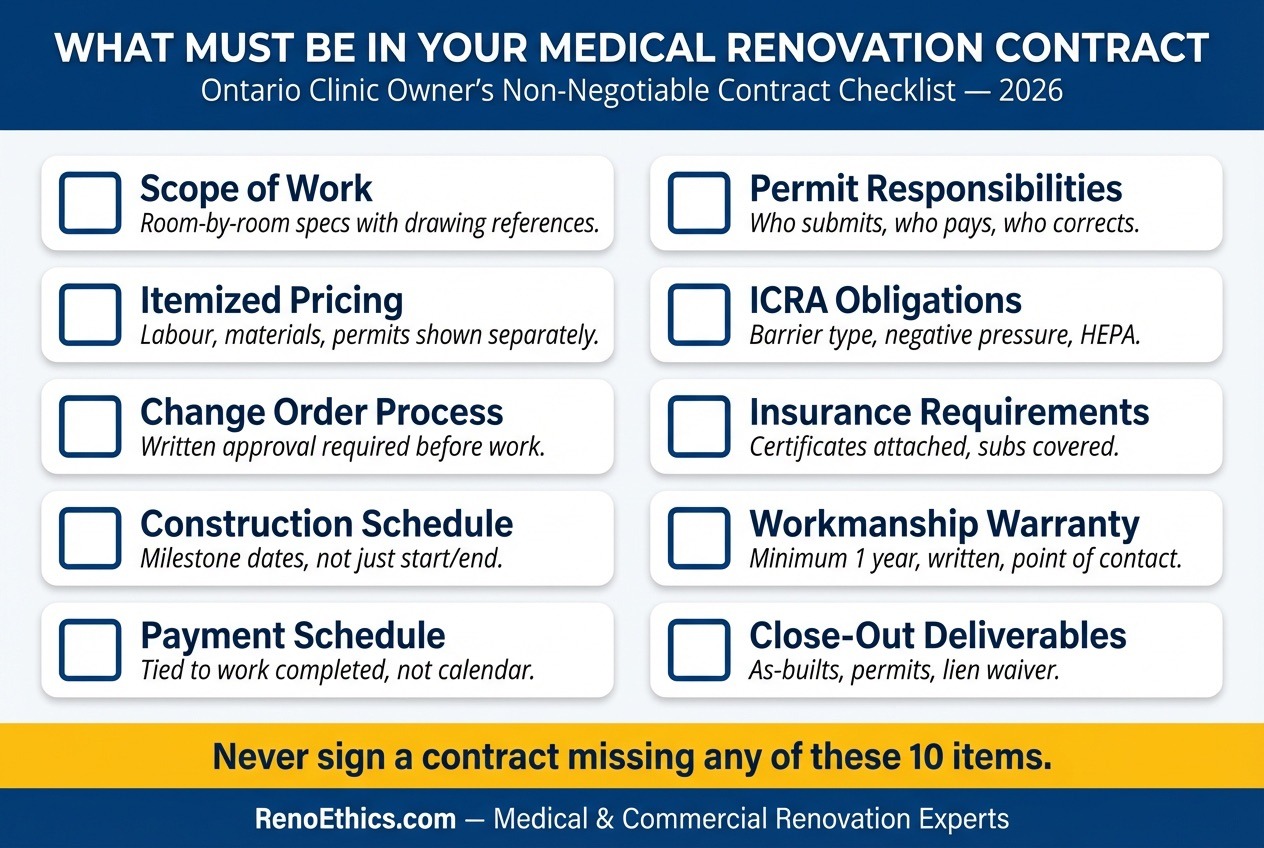
Save and share: Every item on this list must appear in your signed contract before construction begins.
| Contract Section | What It Must Include | Why It Matters |
|---|---|---|
| Scope of Work | Room-by-room description of all work; explicit list of what is excluded; reference to architectural drawings by drawing number and revision date | Prevents "that wasn't in scope" disputes; defines what you're paying for |
| Itemized Pricing | Labour, materials, permits, design fees, and contingency broken out separately; material allowances defined with substitution process | Enables meaningful comparison of quotes; prevents post-signing surprises |
| Change Order Process | Written change orders required before additional work proceeds; pricing approval by clinic owner in writing before work starts; no verbal change orders accepted | The most common source of cost overruns; written process is your only protection |
| Construction Schedule | Start date, milestone dates by phase, substantial completion date, final inspection target date; definition of delay and how it's handled | Keeps contractor accountable; defines what "on time" means |
| Payment Schedule | Payments tied to verified milestone completion — not calendar dates; holdback provisions (10% construction lien holdback required by Ontario law) | Ensures you're not pre-paying for work not yet done; protects against contractor abandonment |
| Permit Responsibilities | Who prepares drawings, who submits permits, who schedules inspections, who pays permit fees, who corrects inspection deficiencies | Prevents the common situation where nobody is clearly responsible for a permit delay |
| ICRA Obligations | Contractor's specific ICRA responsibilities: barrier type, negative pressure maintenance, HEPA filtration, daily inspection, worker transit protocols | Creates legal accountability for patient safety during construction |
| Insurance Requirements | Certificate of insurance attached to contract; all subcontractors required to maintain same coverage; notification required if coverage lapses | Ensures coverage remains active throughout project duration |
| Workmanship Warranty | Duration (minimum 1 year), scope of coverage, exclusions, point of contact for warranty claims, response time commitment | Your only recourse for defects discovered after project completion |
| Close-Out Requirements | As-built drawings, equipment warranty documents, permit inspection records, WSIB clearance at completion, final lien waiver | Documentation required for insurance, future permits, and lease-end restoration |
Ontario's Construction Act requires that you retain 10% of each payment to your contractor as a statutory holdback until the 45-day lien period following substantial completion has expired. Do not release this holdback early, even if the contractor requests it. This holdback protects you from liens filed by subcontractors or suppliers the contractor hasn't paid. Your contract should explicitly reference this requirement.
In medical office renovation, the contractor who submits the lowest quote is almost never offering the best value. Understanding why requires understanding where a low bid comes from — because it always comes from somewhere.
A legitimate healthcare renovation quote that is significantly below competitors usually means one of four things: the contractor has under-scoped the project (missing ICRA requirements, permit fees, healthcare-grade materials, or contingency), they plan to use under-qualified or uninsured subcontractors to reduce labour costs, they intend to make up the difference with change orders once construction is underway and you're committed, or they genuinely lack the experience to know what the work actually costs. None of these outcomes benefit you.
This doesn't mean you should accept any price without scrutiny — it means your scrutiny should focus on scope completeness and credential verification, not on who came in lowest. Compare quotes line by line. If one contractor has included ICRA management, healthcare-grade flooring, permit fees, and a 12% contingency, and another has none of those, you are not comparing two quotes for the same project. You are comparing two entirely different scopes of work.
A properly scoped and executed medical office renovation is also a revenue-generating investment. A well-designed, compliant clinical space improves patient throughput, reduces staff friction, and supports practice growth. For the business case behind renovation investment, our analysis of the ROI of modernizing your medical office provides the financial framework.
A building inspection failure in a medical office renovation means: a stop-work order (all trades go home, daily carrying costs continue), an architect's fee to document the deficiency, rework costs to demolish and rebuild non-compliant elements, re-inspection fees, and schedule delay that may push your reopening date by weeks. In an active clinic, every day of extended construction is a day of disrupted operations. This is why experienced contractor selection — and a complete scope — is always less expensive than fixing a generalist's mistakes.
Work through this checklist for every contractor you are seriously considering. A contractor who cannot satisfy every item on this list should not be awarded a medical office renovation contract.
Portfolio and References
Insurance and Legal
Technical Knowledge
Contract Requirements
At minimum, a medical office renovation contractor in Ontario must hold a valid WSIB Clearance Certificate, general liability insurance of at least $2 million, and ESA-registered electrical subcontractors. For healthcare specifically, look for documented ICRA (Infection Control Risk Assessment) implementation experience, familiarity with CSA Z8000 healthcare facility standards, and a verifiable portfolio of completed clinic projects with contactable references.
Ask for a portfolio of completed medical facility projects with photographs, project descriptions, and direct client contacts. Call at least two references and ask: Did the contractor implement ICRA protocols? Did they manage permits without issues? Were there unexpected cost increases, and how were they handled? Did the project pass all inspections without major deficiencies? Would you hire them again? A contractor with genuine healthcare experience will welcome this scrutiny rather than deflect it.
A general contractor builds and renovates commercial spaces and understands standard building code requirements. A healthcare renovation contractor has additional expertise in ICRA protocols to protect patients during active construction, AODA accessibility standards for medical environments, CSA Z8000 clinical space requirements, healthcare-grade material selection for infection prevention, IPAC compliance, and managing renovations inside active clinical settings without disrupting patient care. These competencies are not interchangeable — they are the result of years of direct healthcare construction experience.
Yes — get at least three quotes, but evaluate them by scope completeness rather than total price alone. A significantly lower bid almost always means the contractor has under-scoped the work (missing permit costs, ICRA requirements, healthcare-grade materials, or contingency) or is planning to use unqualified subcontractors. Compare quotes line by line. A contractor who can explain every line item is far more trustworthy than one who delivers a lump sum. See our medical office renovation cost guide for Ontario benchmark pricing to calibrate whether quotes are realistic.
A proper contract must include: detailed scope of work with room-by-room specifications and reference to architectural drawings, itemized pricing, written change order procedures, construction schedule with milestone dates, payment schedule tied to work completion (not calendar dates), Ontario Construction Act 10% holdback provision, permit and inspection management responsibilities, ICRA protocol obligations, certificate of insurance attachment, written workmanship warranty, and close-out deliverables list (as-builts, warranty documents, permit records). Never sign a contract that lacks these elements.
A reputable healthcare renovation contractor should provide a minimum 1-year workmanship warranty covering defects in labour and materials. Some contractors offer 2-year warranties. This is separate from manufacturer warranties on specific products (fixtures, cabinetry, flooring) which vary by product and supplier. Get the workmanship warranty in writing before signing your contract, and confirm who handles service calls after completion — the contractor directly, or a warranty department — and what the committed response time is.
Contractor selection is one step in a larger planning process. These resources cover the other critical decisions in planning a successful medical facility renovation in Ontario:
RenoEthics serves Richmond Hill, Vaughan, Markham, Aurora, Newmarket, and the broader GTA. We'll provide our WSIB clearance, insurance certificate, healthcare project portfolio, and written ICRA protocols before our first meeting — because a contractor who can't do that before you hire them can't be trusted to protect your patients during construction.
Schedule a No-Obligation Consultation View Our Medical Services
The Mississauga walk-in clinic opened 40 minutes late on its first Monday morning. Twenty-three patients were waiting outside when the staff arrived — a...

The most common question Ontario clinic owners ask when planning a renovation is: “What should this cost per square foot?” It is also the...
The Brampton family medicine clinic closed completely for its renovation. The decision seemed straightforward at the time: a complete 10-week closure would allow the...